What is a Business Quotation? (Meaning & Purpose in Sales)
A business quotation is a formal document that offers goods or services at a fixed price, establishing a legally binding agreement once accepted by the buyer.
Unlike a flexible estimate, a professional sales quotation layout must protect your business’s margins while making it incredibly easy for clients to sign off. A standard business quotation layout must include:
- Itemized Costs & Quantities: Breakdown of every product or service provided to prevent scope creep.
- Fixed Price Guarantee: Clear validity dates indicating how long the offered pricing remains active.
- Terms & Conditions: Explicit payment terms, expected delivery schedules, and client obligations.
💡 Stop wasting time formatting quotations in Word or Excel
Manual sheets often lead to calculation errors, messy alignments, and delayed deals. EasyBilling Invoicing Software provides clean, professional quotation layouts that auto-calculate totals and convert into polished PDFs with one click.
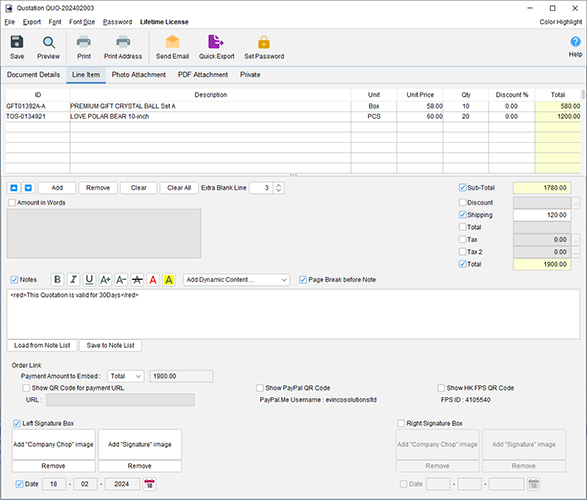
A quotation (often referred to as a quote) is a formal commercial document provided by a seller to a prospective buyer. It explicitly outlines the specific goods or services offered, along with their corresponding costs.
For the buyer, a quotation serves as a transparent cost breakdown, allowing them to budget accurately and compare options before making a purchasing decision. For the seller, it acts as a professional commitment of pricing, which, once accepted, often forms the basis of a legally binding contract.
Essential Components of a Professional Quotation
While modern quotation software offers the flexibility to customize layouts to fit unique business needs, a standard, legally compliant quotation should generally include the following elements:
- Header & Brand Identity
- Letterhead – Your official company name, logo, physical address, and contact details (email and phone number).
- Regulatory Compliance – Depending on your jurisdiction, you may be legally required to display your Business Registration Number, Tax ID, or VAT/GST registration details.
- Document Title – Clearly display the word “Quotation” (or acceptable alternatives like “Quote”, “Estimate”, or “Sales Quote”) at the top.
- Administrative & Tracking Details
- Quotation Number: A unique, sequential identification number. This is crucial for internal tracking, auditing, and seamless communication when discussing the file with the client.
- Issue Date: The exact date the quotation was generated and sent to the client.
- Customer Information
- Customer Profile: The prospective buyer’s company name (or individual name), billing/shipping address, and the primary contact person’s details.
- Line-Item Breakdown
This is the core of the document and must be highly detailed to prevent scope creep:
- Itemized Details: A clear description of each product or service being provided.
- Quantity & Unit Price: The specific volume of items and their individual costs.
- Subtotal & Taxes: The total cost before taxes, followed by a clearly calculated line for applicable taxes (e.g., VAT, Sales Tax), and any discounts applied.
- Grand Total: The final, definitive lump sum the customer is expected to pay.
- Payment & Transaction Terms
- Payment Terms: Explicitly state your expectations. For example: 50% deposit upfront, 50% upon completion, or Net 30 days.
- Payment Methods: Briefly note preferred payment channels (e.g., Bank Transfer, Credit Card).
- Validity & Legal Notes
- Validity Period: Quotes should never be open-ended due to fluctuating material costs or availability. Always include an expiration date (e.g., Valid for 30 days from the date of issue).
- Project Timelines: Anticipated delivery dates or project milestones.
- Disclaimers: Any specific conditions, such as Subject to stock availability or Prices exclude shipping fees.
- Sign-Off & Acceptance
- Authorized Signature: A space for your company’s stamp or authorized signature to validate the offer.
- Client Acceptance: A dedicated section (or digital signature block) where the client can sign and date to formally accept the quote, turning it into an active order.
- Footer
- Pagination: Page numbers (e.g., Page 1 of 3) to ensure the client knows they have received the document in its entirety, along with optional confidentiality notices.